2026 WMJM Retreat
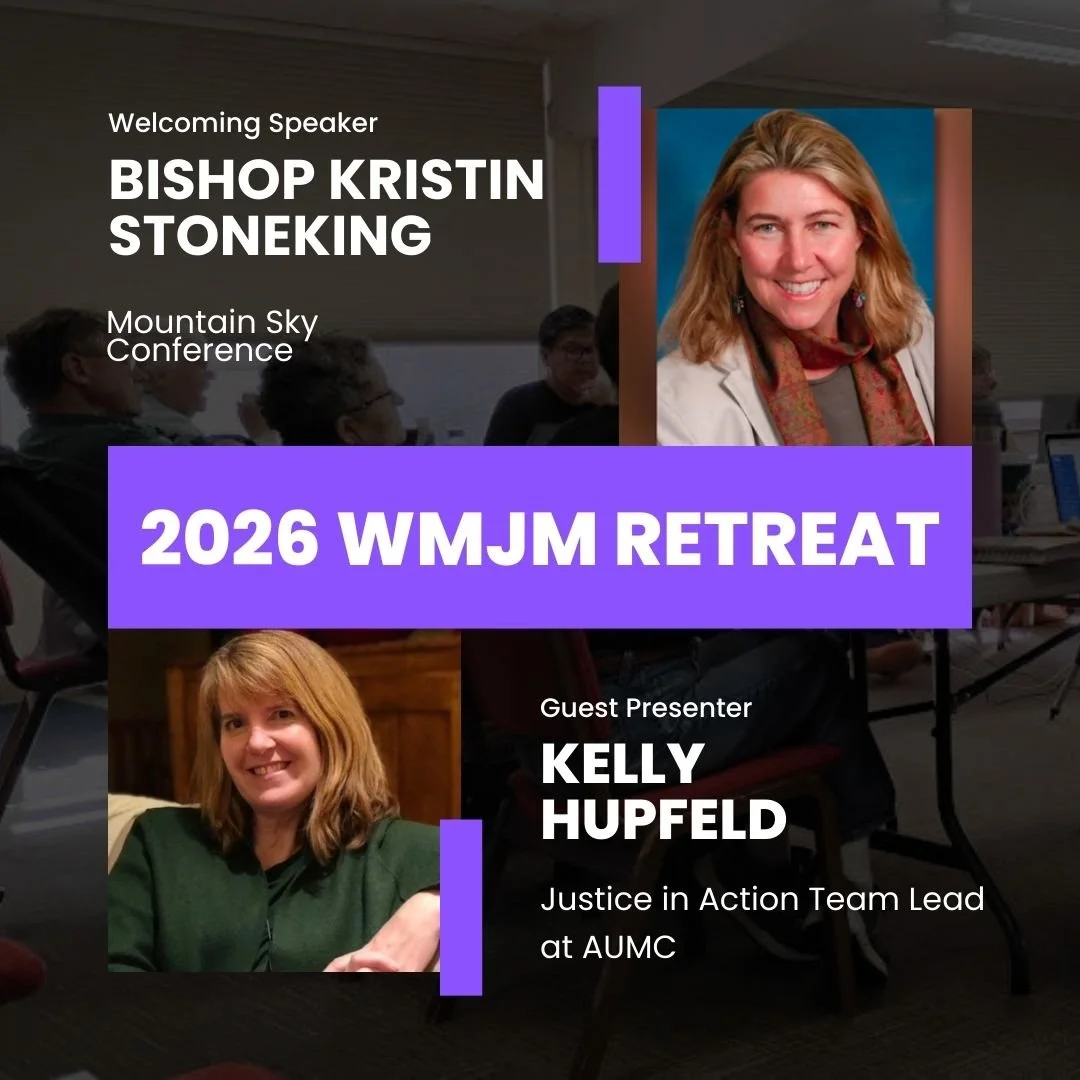
Mountain Sky Bishop Kristin Stoneking welcomed the WMJM leadership team and guests at the recent planning retreat held at Arvada United Methodist Church in Arvada, Colorado. She noted that the Mountain Sky Conference covers one eighth of the contiguous United States, including four states and a church in Idaho.
Stoneking highlighted her experience with justice ministries through the Fellowship of Reconciliation and campus ministry. She also encouraged participants to read Erica Chenoweth’s book Why Civil Resistance Works. Her presence helped focus conversation on how the Western Methodist Justice Movement can assist as the bishops and the Western Jurisdiction continue shaping the United Methodist Church following the changes adopted at the 2020 and 2024 General Conferences.
One ongoing focus of those changes is how the gifts and graces of queer clergy can be more fully welcomed into the itinerant appointment system. Bishop Stoneking is the third openly queer bishop elected by the Western Jurisdiction and brings her experience to this work. Her leadership follows the candidacy of Frank Wulf, WMJM convenor, in 2008 and the later elections of Karen Oliveto, Cedrick Bridgeforth, and Bishop Stoneking.
Participants also discussed the upcoming election of delegates to the 2028 Jurisdictional and General Conferences and how WMJM might engage with the bishops’ leadership gathering scheduled for October in Calgary, Alberta. A conversation about the future of jurisdictions in the United States highlighted the importance of recognizing the different ministry contexts across the church and the varied dynamics involved in electing bishops.
The group also reviewed the history of the movement since its founding in 2012. Earlier gatherings prior to Jurisdictional Conferences in 2004 and 2008, sponsored by the California Pacific chapter of the Methodist Federation for Social Action, helped lay the groundwork for the creation of WMJM. Participants reflected on efforts to support the election of progressive and justice oriented delegates to General and Jurisdictional Conferences and the long work to encourage the election of openly LGBTQ clergy as bishops.
A review of fundraising efforts showed the most success has come when raising support for specific projects or events. One example was the recent effort supporting United Methodist constitutional amendments that establish a regionalized structure for the denomination.
Another highlight of the retreat was a presentation by Kelly Hupfeld of Arvada United Methodist Church about the congregation’s Justice in Action ministry. The presentation explored how churches can connect faith and justice through organized advocacy. More about Hupfeld’s presentation is shared in this article.
Participants also reviewed a communications report with WMJM's Communications Manager, Ashley King. This discussion later led to a conversation about several possible directions for strengthening WMJM's engagement in the future.
There also was a presentation on the recent Kairos Palestine II statement and WMJM was invited to reflect on what makes a justice movement effective.
The work of WMJM has included attention to several key justice concerns. These include racism and white Christian nationalism, with a webinar held in 2025 addressing Christian nationalism. Immigration has also been a focus, although participants noted that many suggested responses are already being addressed by other organizations. WMJM has also supported LGBTQ awareness and advocacy, often amplifying work being done by other groups. Additional areas of focus include health care equity, particularly the state of reproductive rights across the jurisdiction, and maintaining relationships with United Methodists beyond the United States, including leaders in Africa and the Philippines.
In evaluating its work, the leadership team discussed areas of success as well as continuing challenges. The conversation also included reflection on how WMJM can strengthen its role as a network connecting people engaged in justice work across the Western Jurisdiction.
The group discussed qualities that may be helpful for future leadership team members. These include individuals engaged in conference or local social justice work, people who have participated in WMJM projects, and those who bring diverse racial, ethnic, and generational perspectives from across the Western Jurisdiction, which stretches from eastern Colorado and Montana to Hawai‘i and Guam. Other potential leaders may include board members of church and society groups, leaders of ethnic caucuses, and people committed to advancing justice within the church and society.
Participants at the retreat included individuals ranging from a seminarian in New York to participants from the West Coast and the Philippines, some attending through Zoom. Guests included Mountain Sky Bishop Kristin Stoneking, Arvada United Methodist Church pastors Amy Gearhart and Lauren Boyd, Mountain Sky co lay leader Susan McIntosh, Oregon Idaho lay leader Paul Nickell, Arvada United Methodist Church members Kelly Hupfeld and Linda Gertenbach, and retired chaplain Maggie Roe.
The Western Methodist Justice Movement is a voice for justice within the United Methodist Church and the world. The organization provides a venue where progressive people of faith, primarily in the western United States, work together on significant issues of justice and peace within and beyond The United Methodist Church.
