Social Justice in a Local Church : Arvada United Methodist Church
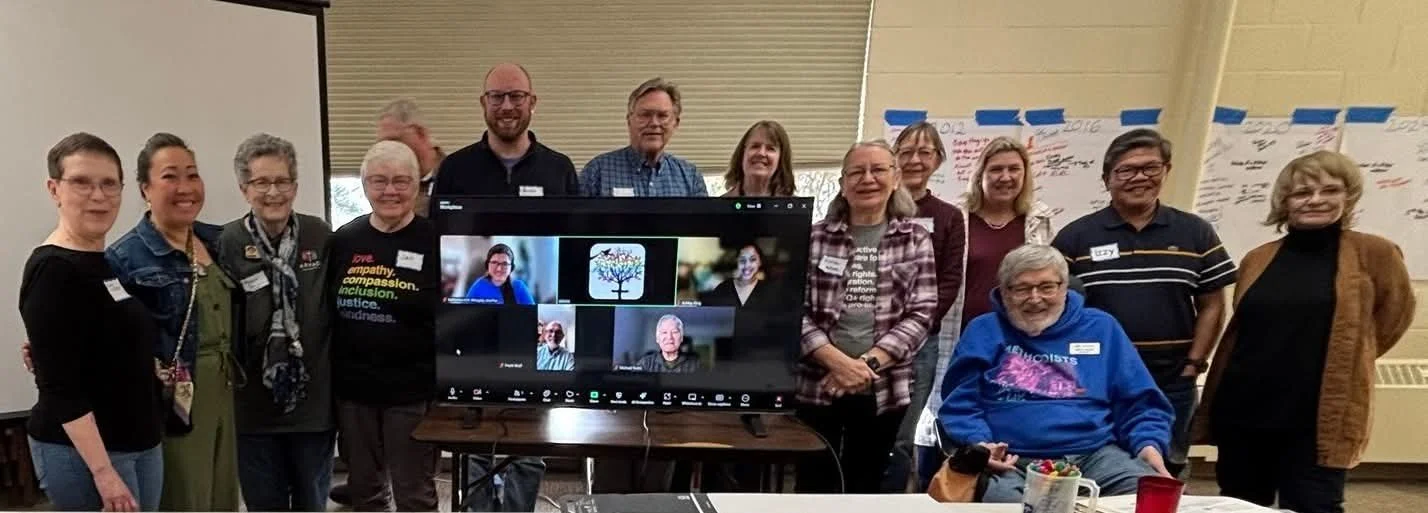
WMJM Leadership Team with Bishop Kristin Stoneking (Mountain Sky), Kelly Hupfeld (AUMC), and Linda Gertenbach (AUMC).
(Photo Credit: WMJM)
At its 2026 retreat, the Western Methodist Justice Movement heard a presentation from two members of Arvada United Methodist Church in Colorado who are involved in the ministry of local church justice work and the connection between faith and social justice. Linda Gertenbach, a retired United Methodist clergy member and participant in the church’s Faith in Action group, and Kelly Hupfeld, a retired lawyer and former associate dean of the School of Public Affairs at the University of Denver, shared about their work. Hupfeld is also a founder of the church’s Justice in Action group.
Arvada United Methodist Church has long identified as a progressive congregation. For many years the church’s Faith in Action group has focused on direct service to neighbors in need. The group partners with three local Title I schools, local food pantries, and other service organizations. The church regularly holds food drives to support nutrition needs and fundraising activities that assist families who need help. Volunteers also prepare and serve meals for guests at two shelters for people experiencing homelessness.
This work has naturally led to advocacy. Serving meals to unhoused neighbors has prompted church members to speak with the city council and other officials about addressing homelessness in the community. The church also partners with other congregations through Habitat for Humanity to provide housing.
Arvada United Methodist Church supports global ministries as well. These include Far Away Friends, which operates schools in Uganda, and Pura Vida Ministries, which provides scholarships for students and supports community projects in Guatemala. Throughout the year the Faith in Action group supports these organizations through financial collections, educational events, and mission trips.
For many people engaged in service, this movement from charity to advocacy develops over time. As individuals see the needs within their communities, they also begin to recognize the policies and systems that contribute to those needs. This awareness often leads to deeper engagement with justice work.
The Justice in Action committee focuses specifically on advocacy. Members of the two groups met together to clarify the differences between their work. They describe the distinction this way: mercy means helping those with immediate needs, while justice means ensuring the human rights and dignity of all people.
When the Justice in Action group began developing a mission statement based on the United Methodist Social Principles, pastors at the church were already preaching about the events unfolding in society. They spoke about these issues while recognizing the range of perspectives within the congregation and emphasizing the shared call to live with love in the world. This leadership helped address a common challenge in progressive Christianity, which often struggles to communicate clearly how faith connects with social issues.
The United Methodist Social Principles were first adopted in 1908 and were revised in 2024. These principles help guide the church’s understanding of how faith relates to justice in the wider world.
The committee continues to educate the congregation about the updated Social Principles. Members want people to see how Christians can put their faith into action. One approach has been to set up a justice table in the church’s narthex where members can learn about ongoing work. The goal is to bring people together to share their frustrations, address feelings of helplessness, and take meaningful action. The group refers to this work as creating “good trouble,” echoing the phrase used by civil rights leader and member of Congress John Lewis.
The committee has also identified several topic areas where people can learn more and volunteer their time.
A weekly electronic action alert for the Denver metro area suggests several ways to become involved. These opportunities may include attending an event, participating in a march, learning about an issue, donating to an organization, or sharing information with others. The alert also includes a section titled “What is yours to do this week?” It invites readers to consider questions such as: What is mine to say or do? What is mine to not say or not do?
The newsletter also includes educational information and statements addressing current concerns. Messages from bishops and other denominational leaders may also be shared. Because many of these resources include links, the newsletter is distributed electronically.
Committees doing this work must ask several questions. Who is the congregation? What do members need to know? What interests and skills does the person producing the newsletter bring to the task?
Educational events can also help address important questions. What does faith say about justice issues? What is happening in the community around these concerns? Congregations can organize groups to attend events and public demonstrations together so that their voices are heard in the community.
Justice committees often focus on issues affecting people in real time. These may include immigration enforcement or other government policies that impact vulnerable communities. Building relationships with people in other congregations and justice organizations is also essential.
The Justice in Action team at Arvada United Methodist Church is entirely volunteer led. Three co-chairs guide the work, recognizing that no single person has the capacity to manage everything alone. The group continues to look for other United Methodist congregations that want to participate in this work, though finding those partners can sometimes be difficult. Recently the committee has begun working with Together Colorado, an interfaith coalition that advocates on state legislative issues.
Members also described how communities can prepare for moments of crisis. In Minneapolis, strong networks of observers and mutual aid organizations helped the community respond during immigration enforcement actions. Arvada United Methodist Church plans to host training sessions for immigration enforcement observers and currently serves as a hub for mutual aid supplies connected to several local schools.
The church’s justice work also addresses issues such as homelessness and sustainability policies in the city of Arvada. The Justice in Action group does not limit its focus to a single issue, although some congregations may choose to concentrate their efforts in one area.
Those beginning similar work in their own churches are encouraged to start locally. First build a foundation within the congregation. Then connect with other churches in the area and with justice organizations in the broader community. Communication is essential. Pastors play an important role by supporting the work and speaking about key issues during worship.
Linda Gertenbach noted that charity work often becomes the entry point for justice advocacy. When congregations host workshops on social issues, they can also provide information about how people can participate in advocacy with their state legislature or other decision making bodies. She emphasized that there is space for everyone in this work.
Developing local church justice and mercy ministries can serve as a powerful witness to the depth of Christian faith and to God’s love and care for all.
